On paper, Viator looks like a gift. Bookings appear in your inbox, seats fill up, and you barely have to lift a finger. For a tour and activity business. especially a hot air balloon operator with high fixed costs and a short flying window. that feels like free money.
It is not free. It is the most expensive money you will ever take. And most operators do not realise just how expensive until they sit down and actually run the numbers.
If you are doing even a few hundred bookings a year through Viator, there is a very real chance your business is leaking $60,000, $100,000, or more in pure profit. every single year. and you cannot see it because it never hits your bank statement as a line item called "loss."
This article breaks down exactly where that money goes, why the OTA model is structurally rigged against operators, what it costs you over a 5-year window, and the step-by-step framework we use to move balloon operators from OTA dependency to direct-booking dominance.
Why this matters right now
We work exclusively with hot air balloon operators across Cappadocia, Luxor, Dubai, the US, and Europe. Across every market, the pattern is identical: the operators who quietly own their region are the ones who have built a direct-booking engine. The operators who feel busy but never seem to grow their bank balance are the ones still funnelling 60-90% of their bookings through Viator and a handful of other OTAs.
The OTA model was never designed to make operators rich. It was designed to make the OTA rich while keeping you just dependent enough not to leave.
The real problem is not the commission. It is the dependency.
Most operators look at Viator's 20-30% commission and decide it is a fair price for the volume. That math only works if you ignore everything else the OTA quietly takes from you. The commission is the visible cost. The dependency is the cost that actually breaks the business.
When Viator becomes your main source of demand, four invisible costs start compounding at the same time. and together they dwarf the commission line.
Hidden cost #1: The margin you never see
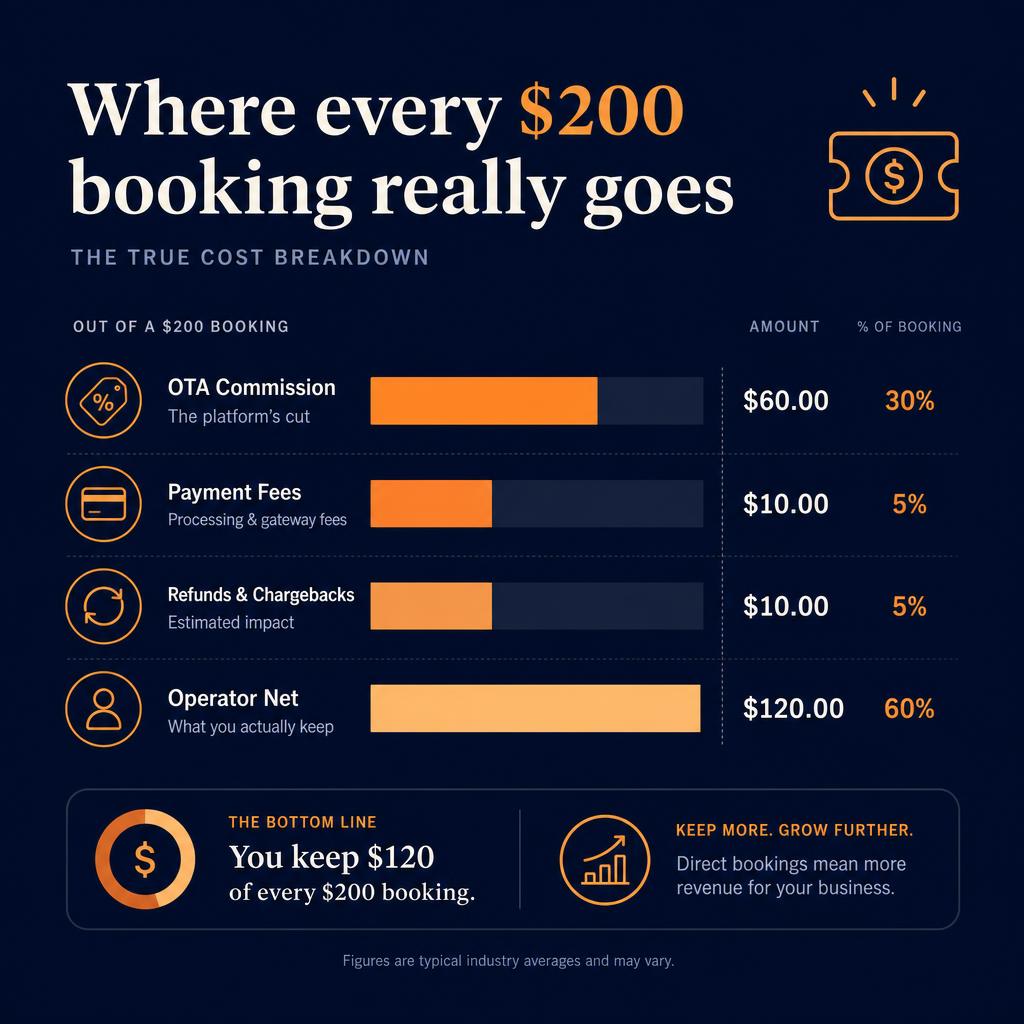
A 25% commission on a $200 flight is $50. That feels manageable until you remember your gross margin on that flight is maybe $90 after fuel, crew, insurance, vehicles, and overhead. The OTA is not taking 25% of your revenue. It is taking 55%+ of your actual profit.
Now do that 400 times a year and you have just handed a single platform $20,000 of pure margin that should have been used to buy a new envelope, hire a better pilot, or run your own ads.
Hidden cost #2: You do not own the customer
Viator owns the email. Viator owns the review. Viator owns the post-booking communication. You fly the customer, deliver the experience of a lifetime, and the platform takes the relationship.
That customer never enters your email list, never sees your retargeting ads, never gets a Valentine's offer next February, and never refers a friend back to your brand. they refer them back to Viator. You paid the full cost of acquisition and got a one-night stand instead of a relationship.
Hidden cost #3: You compete on price inside a marketplace you do not control
The moment a second operator in your region lists on Viator, you are in a knife fight. The platform sorts by price, conversion rate, and review velocity. not by experience quality. Your beautiful 25-year-old family-run operation now ranks underneath a 2-year-old competitor with a cheaper offer and a slicker thumbnail.
The only way to win that fight is to drop your price, which drops your margin, which means you need more bookings to stay even. which makes you more dependent on the platform. That is not a marketing channel. That is a treadmill.
Hidden cost #4: Your brand becomes invisible
When 70% of your customers find you through Viator, almost nobody is searching for your brand name on Google. Your organic demand never builds. Your social proof goes to the platform's profile, not yours. New visitors who do land on your site have no reason to trust you because there is no momentum behind your name.
Stop paying Viator for 90 days and most operators discover their direct demand is effectively zero. That is not a healthy business. That is a Viator branch office wearing your logo.
Hidden cost #5: One algorithm tweak can wipe out your year
OTAs adjust their ranking algorithms constantly. We have personally watched operators lose 40% of their monthly volume overnight because Viator surfaced a new "top experience" badge they did not qualify for, or rolled out a discount programme they were auto-enrolled into. You had no warning, no recourse, and no second channel to absorb the hit.
Want to see your real Viator leak?
Grab our free OTA Profit Leak Calculator. Plug in your bookings, average ticket, and commission rate. get the exact 12-month number in under 60 seconds.
Get the free calculator →What this actually costs you over 5 years
Let's run honest numbers on a mid-size operator: 600 bookings a year through Viator at an average ticket of $220 and a 25% commission.
- Commission paid per year: $33,000
- Lost repeat revenue (35% of customers would have re-booked direct within 3 years at $220): ~$46,200
- Lost referral revenue (1 referral per 4 happy guests at $220): ~$33,000
- Lost email/SMS revenue from a 6,000-contact list never built: $40,000+
- Conservative 5-year hidden cost: $750,000+
That is not a typo. The $33,000 commission line is roughly 4% of the true 5-year cost of being OTA-dependent. Everything else is silent.
What it looks like when an operator escapes
One European operator we work with came to us doing roughly 1,100 flights a year, with 78% of bookings flowing through Viator and GetYourGuide. Net margin was thin enough that one bad weather month could put them in the red.
Before
- 78% OTA bookings, 22% direct
- Average effective commission: 27%
- Email list: 412 contacts
- Direct branded search per month: 90
After 9 months
- 44% OTA bookings, 56% direct
- Blended customer acquisition cost on Meta: 9% of revenue
- Email list: 11,400 contacts driving $18k/month in repeat and referral revenue
- Direct branded search per month: 2,300+
- Net profit up 71% on roughly the same flight volume
Nothing about the experience changed. They flew the same balloons, the same crew, the same fields. They simply stopped renting their demand and started owning it.
Curious what your version of this looks like?
Book a free 30-minute Direct Booking Audit. We'll review your current OTA mix, ad accounts, and funnel. and show you exactly where the leaks are.
Book my free audit →The 5-step framework to move from OTA dependency to direct booking dominance
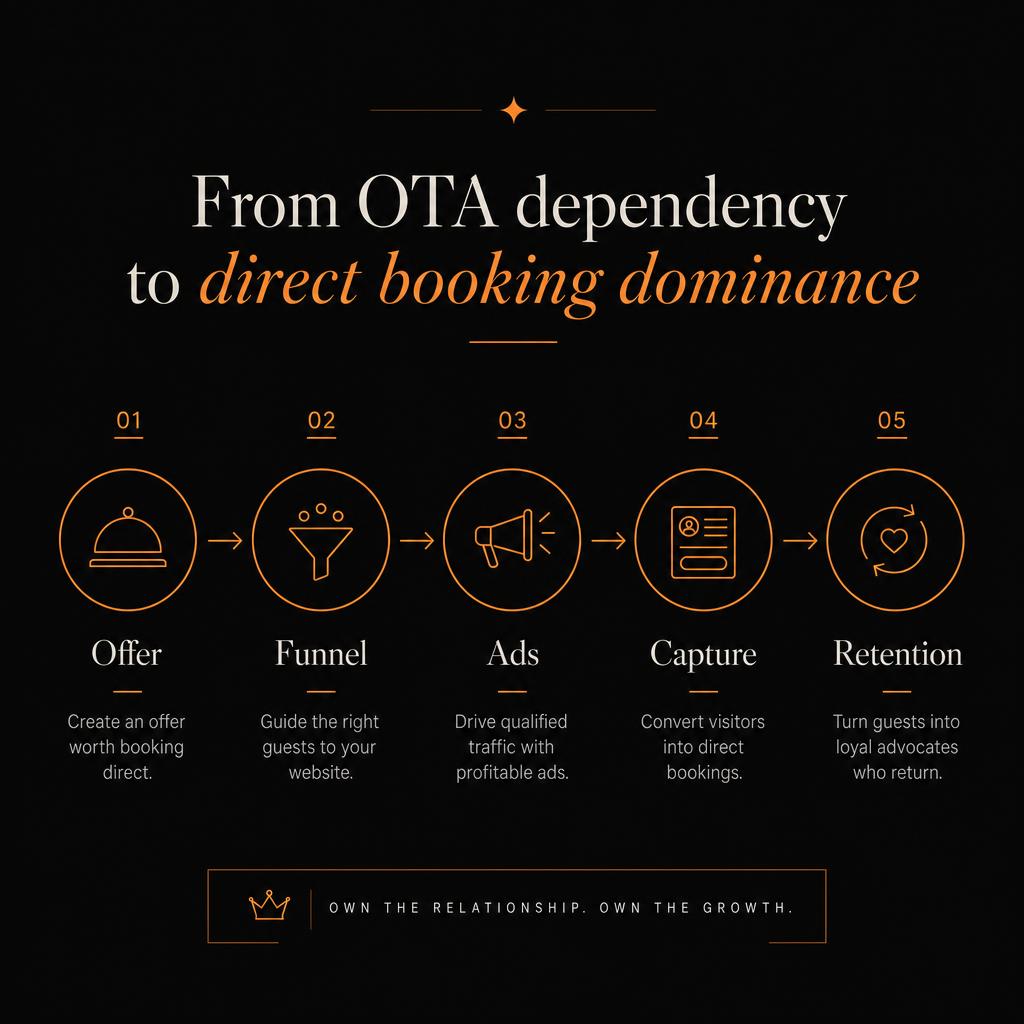
Step 1. Build an offer worth booking direct
Travellers will only bypass Viator if you give them a reason. That means a clearly better direct experience: a guaranteed seat, a price-match, a premium add-on, a private basket upgrade, or a champagne package they cannot get on the OTA. Match the OTA price and add something the OTA cannot.
Step 2. Fix the funnel before you fix the traffic
Most operator websites are brochures, not booking machines. You need a conversion-optimised landing page per offer, clear social proof, real flight footage, transparent pricing, and a one-screen booking flow. Send Meta traffic to a generic homepage and you will burn every dollar.
Step 3. Turn on Meta Ads with the right structure
Cold prospecting in your top feeder geographies, retargeting for site visitors and 75% video viewers, lookalikes off your past customers. Optimise for the Purchase event, not clicks. Refresh creative every 21 days.
Step 4. Capture every visitor you do not convert
Most operators lose 95% of their traffic. Add an exit-intent offer, a weather-update opt-in, an SMS waitlist, and a guide download. Build the email/SMS list as if it were a balloon. pressure on it every day.
Step 5. Retention is where the real money lives
Automated post-flight sequences, anniversary offers, referral incentives, corporate gift-voucher campaigns, off-season win-back flows. A balloon flight is one of the most emotional purchases a person ever makes. your retention engine should reflect that.
Your action plan, starting this week
Do this in the next 7 days
- Pull your last 12 months of OTA payouts and calculate your real effective commission %.
- Run our OTA Profit Leak Calculator and write the 5-year number on a post-it on your monitor.
- Add one direct-only offer to your site that does not exist on Viator.
Do this in the next 30 days
- Install the Meta Pixel and Conversions API. Define Purchase, InitiateCheckout, and Lead events.
- Build one conversion-optimised landing page for your hero offer.
- Launch one cold Meta campaign and one retargeting campaign with a 50/50 budget split.
Do this over the next 6 months
- Reduce OTA dependency from whatever it is today to below 50% of bookings.
- Grow your email list past 5,000 contacts and build a 6-email post-flight automation.
- Establish a repeatable monthly content + ads + retention rhythm so direct demand compounds.
The bottom line
Viator is not the enemy. Dependency on Viator is the enemy. Used as one channel among many, OTAs have a role. Used as your entire marketing strategy, they will quietly drain the most valuable asset your business has. the customer relationship. and charge you a commission for the privilege.
The operators who will dominate the next decade of hot air ballooning are not the ones with the cheapest tickets or the most listings. They are the ones who own their audience, control their demand, and decide their own margins. Everyone else is just renting a business they will never get to keep.
Ready to stop renting your business from Viator?
Book a free 30-minute strategy call with our team. We'll map a direct-booking funnel to your specific launch fields, your offers, and your margin targets. no slides, no fluff, just the plan.
Book my free strategy call →Frequently asked questions
+Is Viator actually bad for tour operators?
Viator is not bad as one channel in a balanced mix. It becomes destructive when it grows past roughly 40% of your bookings, because at that point the platform. not you. controls your pricing, your customer relationship, and your growth.
+What commission does Viator take from hot air balloon operators?
Effective commissions typically range from 20% to 30% depending on contract tier, promotions enrolled in, and currency. Once you add payment fees, refund risk, and discount programmes, the true cost frequently exceeds 30%.
+Can I cancel Viator entirely?
You can, but it is usually unnecessary and risky. The smarter play is to build direct-booking channels alongside Viator until OTA bookings drop below 30% of revenue. then renegotiate or reduce listings without taking a revenue hit.
+How long does it take to reduce OTA dependency?
With a properly built funnel, paid social, and email/SMS retention, most operators we work with move from 70%+ OTA dependency to under 50% within 6 to 9 months, without losing total booking volume.
+Do Meta Ads really work for hot air balloon companies?
Yes. better than for almost any other tourism product. Ballooning is visual, emotional, and bucket-list, which are exactly the buying triggers Meta's algorithm and creative formats are built to amplify. Operators commonly see 6-12x ROAS on retargeting and 3-5x on cold prospecting.